The game we play
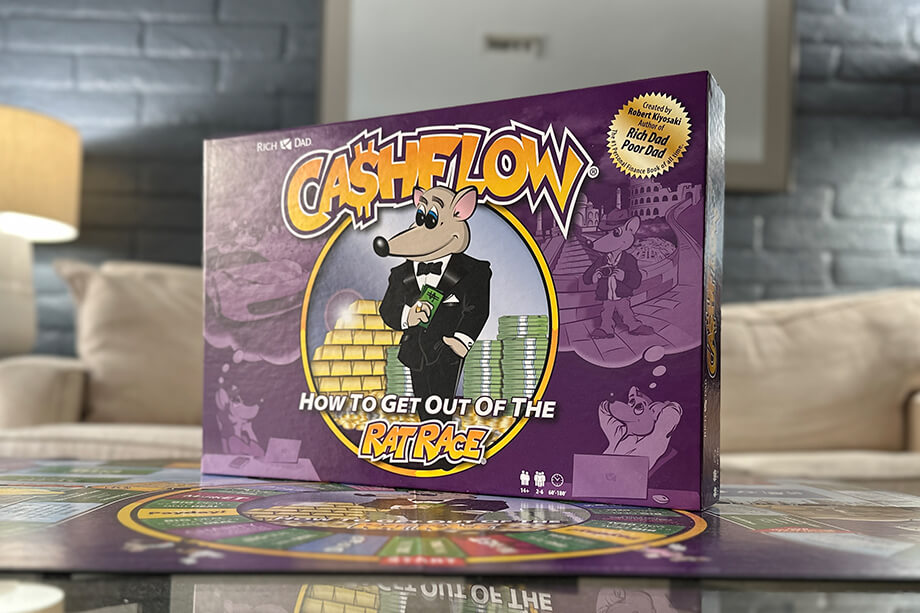
The CASHFLOW® board game
A financial education board game created by Robert Kiyosaki, author of Rich Dad Poor Dad, and Kim Kiyosaki. You win by building income from assets until you can leave the Rat Race.
- 1996First released
- 14+Recommended age
- 2–6Players
- 1–3Hours a game
What CASHFLOW is
CASHFLOW is an investing simulator played on a board. Every player starts with a job, a salary and a set of monthly expenses, and keeps a personal financial statement throughout the game.
Luck does not decide the winner. You win by buying assets that pay you every month, such as real estate, stocks and businesses, until that income covers your expenses and you can leave the Rat Race.
Along the way you practice the work investors do: weighing a deal, using debt on purpose, and working out the return. Cards called Doodads, the small purchases that drain your cash, keep getting in the way.
Each game plays out differently, and each one shows you something about your own habits with money.
What the game teaches
The game hides the arithmetic of accounting inside friendly competition. By the end you will have practiced all of this:
- Acquiring assets that move you out of the Rat Race
- Telling an asset from a liability
- Building passive income that can replace a paycheck
- Filling in a personal financial statement, even if you have never done one
- Seeing how the rich, the middle class and the poor think about money differently
- Understanding why a paycheck alone will not make you rich
- Recognizing your own money habits
- Thinking critically about financial decisions
- Talking about money openly with the people you play with
Who the game is for
Families
Children learn the difference between assets and liabilities, how to manage money and why long-term thinking matters, by playing instead of being lectured.
Homeschoolers
Families who teach at home use the game to bring budgeting, entrepreneurship and economics to life through action.
Adults
From teenagers to retirees. It suits anyone preparing for college, starting a side business or planning for retirement.
CASHFLOW and Monopoly®
Both are board games about money. They ask you to do different things.
| Monopoly | CASHFLOW | |
|---|---|---|
| Created | Charles Darrow, 1935 | Robert Kiyosaki, 1996 |
| Goal | Be the richest player by bankrupting the others | Leave the Rat Race and reach financial freedom |
| How you win | Be the last player with money and property | Replace earned income with passive income |
| Strategy | Buy properties, collect rent, eliminate opponents | Acquire assets that produce passive income |
| Debt | Usually avoided, since it can end your game | A tool you use on purpose to invest |
| Cash flow | Not a focus | The center of the game: income, expenses, liabilities |
| Investments | Real estate only | Real estate, stocks, businesses and more |
| What you practice | Basic math and negotiation | Personal finance, accounting and investing |
| Pace | Can be slow, and players are eliminated early | Faster, and nobody is eliminated |
| Recommended age | 8 and up | 14 and up, because of the financial concepts |
| Playing again | The same strategy tends to repeat | Each game changes with the choices you make |
Questions about the game
- How long does a game take?
- A first game can take three to four hours. Once you know the rules, it moves faster.
- Can children play?
- The game is recommended for ages 14 and up. Younger players who are comfortable with numbers often manage it with an adult at the table.
- Is it hard to learn?
- It takes a little while to understand the financial statement. After that the game runs smoothly, and at our workshop a facilitator guides you through it.
- Will it help me understand investing?
- Yes. Stocks, real estate and small businesses all come up, and you learn by making the decisions yourself. The game is education. It does not promise a financial result.
Play it with a facilitator
At a CASHFLOW Club Thailand workshop you play the full game in one day, with a facilitator coaching your table.